
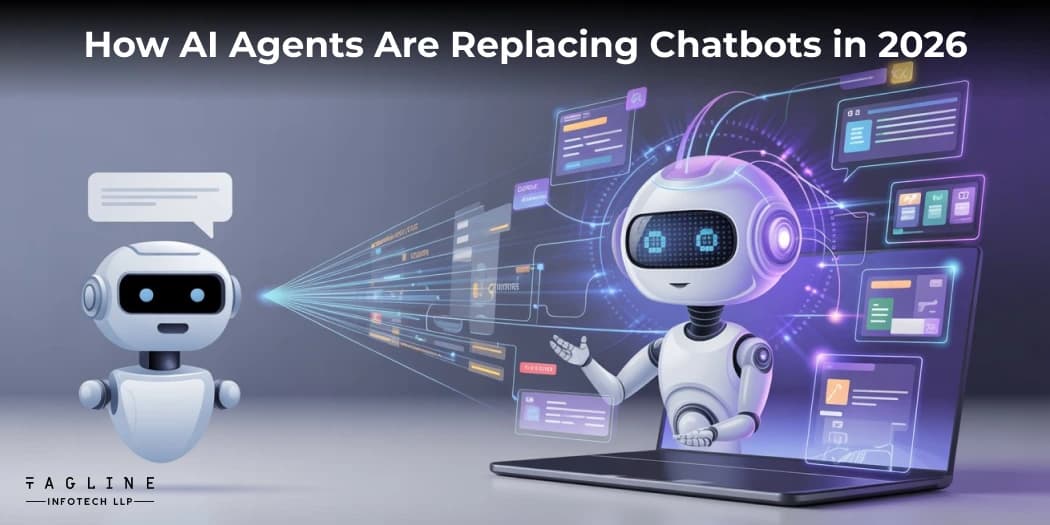
How AI Agents Are Replacing Traditional Chatbots in 2026

Written by Crexed
May 12, 2026
Search interest in “AI agents” is exploding, but most businesses still think an agent is just a better chatbot. That confusion is creating a huge opportunity for teams that can explain the difference clearly and ship production-grade systems.
In 2026, the gap is simple: chatbots answer questions, while agents complete outcomes. Agents can plan steps, call tools (CRMs, ticketing, billing, calendars), and follow policies to finish work not just respond.
This guide breaks down what an AI agent is, how it differs from a traditional chatbot, and the most valuable real-world use cases: customer support agents, AI sales agents, and voice agents plus cost savings and future trends.
What Is an AI Agent?
An AI agent is a goal-driven system that can decide what to do next, use tools to take actions, and verify results before continuing. Instead of a single prompt → single response, agents run a loop: understand intent, plan steps, execute calls (APIs/DBs), observe outputs, and complete the task within permissions and policy.
In practice, “agent” usually means an LLM paired with: tool calling, structured workflows, memory (session + long-term), business rules, and observability. The model provides reasoning and language; the system provides reliability.
Difference Between a Chatbot & an Agent
Traditional chatbots are primarily conversation interfaces. They’re great for FAQs, basic routing, and collecting information. Agents go further: they can actually complete multi-step work (with guardrails), which is why they’re replacing chatbots for higher-value workflows.
Goal
Chatbot: answer questions. Agent: achieve outcomes (resolve, book, refund, qualify, update).
Actions
Chatbot: limited actions, often human handoff. Agent: calls tools/APIs, updates systems of record, and tracks state.
Reasoning Loop
Chatbot: mostly single-turn replies. Agent: plan → act → observe → refine until done (or escalate).
Safety & Control
Chatbot: prompt rules. Agent: permissions, policy checks, validation, audit logs, and human-in-the-loop approvals.
Why this topic works in 2026: there’s huge search demand, businesses are actively confused about “agents vs chatbots,” and the difference maps directly to high-intent services (strategy, integration, evaluation, deployment, monitoring).
Real Business Use Cases (Where Agents Beat Chatbots)
If a workflow has more than one step, touches multiple systems, or requires checking constraints, an agent architecture usually outperforms a traditional chatbot. The best use cases share three traits: clear success criteria, tool access, and safe fallback paths.
Ticket Resolution
Classify intent, pull account context, apply policy, execute a fix (refund/replace/reset), and confirm completion.
Lead Qualification
Ask dynamic questions, enrich data, score fit, schedule meetings, and push updates to CRM automatically.
Order & Billing Ops
Track shipments, update addresses, apply discounts, generate invoices, and notify customers proactively.
Internal Ops Assistants
Answer with company context, draft SOPs, open IT requests, generate reports, and route approvals.
AI Agents for Customer Support
Support is the fastest path to ROI because it’s high-volume, repetitive, and measurable. A support agent can resolve issues end-to-end when it’s safe, and escalate with a complete summary when it’s not.
Context Retrieval
Pull user profile, order history, previous tickets, and relevant policy/SOP snippets before responding.
Actionable Resolutions
Trigger refunds, replacements, resets, cancellations, or plan changes through authenticated APIs.
Quality Guardrails
Validate eligibility rules, rate-limit risky actions, and require approval for edge cases (fraud, high $ value).
Handoff Done Right
When escalation happens, the agent generates a clean timeline, attempted steps, and suggested next action.
AI Sales Agents (From Chat to Conversion)
Sales chatbots often fail because they can’t personalize and they don’t move opportunities forward. Sales agents can qualify, route, and push work into real sales systems, creating measurable conversion lift.
Qualification That Adapts
Adjust questions based on industry, company size, intent, and objections without feeling scripted.
CRM Automation
Create/update leads, log conversation summaries, and assign the right rep based on rules and territory.
Scheduling & Follow-Ups
Book meetings, send reminders, and handle reschedules while keeping the rep looped in.
Offer & Proposal Drafting
Generate tailored proposals using approved templates and pricing constraints, then route for approval.
AI Voice Agents (Calls, Not Just Chats)
Voice is where agents become a true front-line operator. Modern voice agents combine speech-to-text, an agent decision loop, and text-to-speech plus strong latency control and compliance.
Inbound Support Calls
Authenticate the caller, troubleshoot step-by-step, execute account actions, and confirm resolution verbally.
Outbound Reminders
Confirm appointments, collect missing details, and update records automatically.
Call Summaries
Generate structured notes (reason, outcome, next step) and attach them to CRM/ticketing tools.
Compliance Modes
Disable sensitive actions, redact PII in logs, and require explicit confirmations for policy-critical steps.
Cost Savings (What Businesses Actually Gain)
Agents reduce cost by shifting work from humans to automation and by reducing “ping-pong” between teams. The biggest wins come from faster resolution times, fewer escalations, and cleaner data in systems of record.
Lower Cost per Resolution
Resolve common issues automatically and keep humans focused on complex, high-empathy cases.
Faster Time-to-Value
Agents can operate 24/7 and handle spikes without hiring cycles or scheduling constraints.
Reduced Rework
Structured outputs (fields, actions, logs) cut the time spent cleaning CRM/ticket data later.
Better Conversion Economics
Sales agents can qualify and book meetings instantly, reducing drop-off from slow follow-ups.
Future Trends (What’s Next After 2026)
The next wave isn’t “more chat.” It’s agent systems that are more controllable, more observable, and more specialized. The winners will be teams who treat agents like production software, not demos.
Agent Orchestration
Multiple specialized agents (support, billing, scheduling) coordinated through clear routing and shared policies.
Stronger Evaluations
Automated test suites for hallucinations, policy violations, tool failures, and edge-case customer scenarios.
Permissioned Tooling
Fine-grained scopes (read vs write) and approval workflows for sensitive actions and high-impact changes.
Voice + Multimodal Front Doors
Voice, chat, and vision inputs feeding the same agent brain for richer context and fewer user steps.
If you’re building in this space, the fastest path is to start with one workflow (support or sales), integrate the core tools, add guardrails, and ship. That’s where agent projects convert because the business value is immediate and measurable.